
ITIL 4 Service Value Chain: The Core of Modern Service Management
Understanding the Service Value Chain Activities
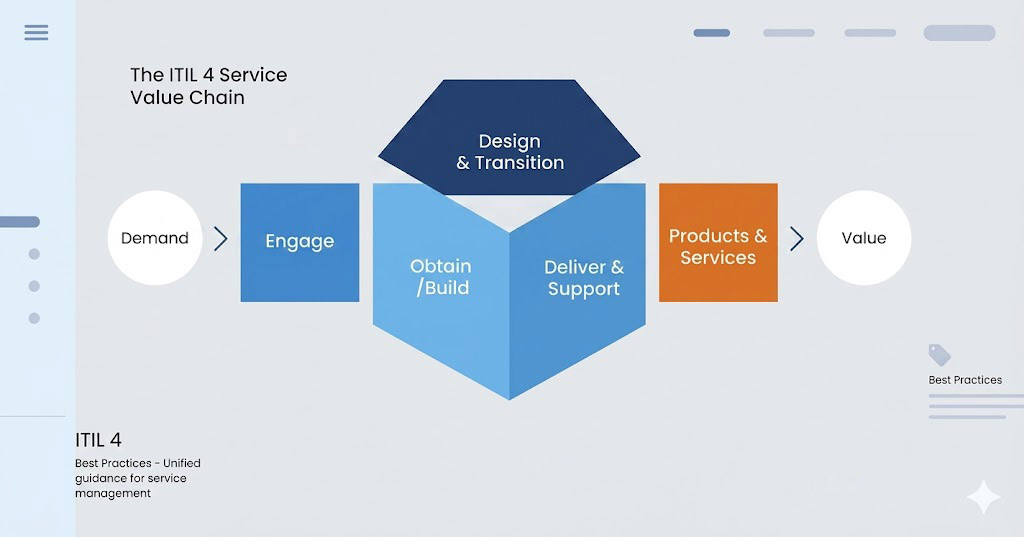
The SVC is composed of six key activities. These are not a linear checklist, but a set of interconnected blocks that can be combined in various sequences (Value Streams) to meet specific demands.
1. Engage
Engagement is the catalyst. This activity ensures a deep understanding of stakeholder needs.
Whether you are following DevOps, Agile, or Lean methodologies, “Engage” is the mandatory step where collaboration begins. It transforms raw Demand into a shared vision of Value.
2. Plan
The Plan activity provides a shared understanding of the vision, current status, and improvement direction for all four dimensions of service management.
It ensures that every action aligns with the organization’s strategic goals.
3. Improve
Improvement is not an afterthought; it is embedded throughout the lifecycle.
By learning from every outcome, organizations can remove constraints and enhance their capability to solve complex problems.
4. Design & Transition
This activity ensures that products and services continually meet stakeholder expectations for quality, cost, and time-to-market.
It bridges the gap between a conceptual solution and a live service.
5. Obtain / Build
This is where the components are created or acquired. Whether you are developing an API in-house or sourcing a SaaS solution from a partner, this activity ensures that the right “building blocks” are available when needed.
6. Deliver & Support
Value is only realized when services are in the hands of the user.
This activity ensures that services are delivered and supported according to agreed specifications.
High-quality support depends on active Engagement between the provider and the consumer.
From Demand to Value: The Strategic Shift
The ultimate output of the Service Value Chain is Value, realized through Products and Services. In a digitally disruptive market, speed is irrelevant if the quality is poor. Key Insight: Value is not determined by the provider, but by the consumer. True worth is measured by how well a service enables a customer to achieve their goals.
Element
11111119829_1a3a19-82>
Focus
11111119829_b29861-f4>
B2B Impact
11111119829_ba3128-5b>
Demand
11111119829_f08807-81>
Internal/External Needs
11111119829_de5069-b5>
Identifies market opportunities and pain points.
11111119829_d9ca0b-06>
Value Streams
11111119829_3ffb31-7f>
Process Integration
11111119829_74e075-6c>
Breaks down silos between Ops, Dev, and Business.
11111119829_0c1419-3a>
Feedback Loops
11111119829_98adaf-66>
Continuous Improvement
11111119829_15a8f6-59>
Ensures long-term ROI and customer retention.
11111119829_f91026-44>
Optimize Your Service Delivery
The ITIL 4 Service Value Chain is more than a diagram—it is a mindset.
By focusing on Engagement and Value-driven outcomes, your organization can build faster, safer, and more resilient technology services.
Ready to transform your IT operations? Explore our advanced ITSM resources or consult with our experts to map your unique Value Streams.

There is a universal mandate echoing across the modern enterprise: spend less, deliver more. While conventional wisdom suggests that acquiring more tools naturally accelerates productivity, the reality is often the opposite. Today, many organizations are bleeding budgets—not due to a lack of resources, but because of overinvestment in redundant, underutilized software. Enterprise Software-as-a-Service (SaaS) portfolios have become…
Is your SD-WAN service vulnerable to broadband outages? Traditional backup solutions like 5G extenders are expensive, and Metro Ethernet circuits come with high costs and long lead times. The eSIX solution—the smart way to ensure business continuity and maximize your network investment. The Challenge: Unreliable Broadband & Costly Backup for SD-WAN Modern SD-WAN devices, like the…
The Growing Threat of API Vulnerabilities Recent studies show 83.9% of consumers demand better security from businesses, while 80.9% report worsening cyber threats. High-profile breaches like Instagram’s 6 million-user API leak (where hackers sold data at $10 per record) prove no company is safe. Why APIs Are the New Hacker Target Mobile apps rely on unsecured backend APIsHackers exploit authentication flaws to bypass…
Security Operations Center (SOC) Roles and Responsibilities A security operations center, or SOC, is an organizational or business unit operating at the center of security operations to manage and improve an organization’s overall security posture. Its primary function is to detect, analyze and respond to cybersecurity events, including threats and incidents, employing people, processes and…
IT infrastructure forms the technological bedrock of today’s banking sector, enabling secure data control, regulatory compliance, and seamless digital experiences. At GOIP Group, we understand that strategically designed infrastructure protects operations while empowering customers and employees in an increasingly digital landscape. Financial institutions now face critical infrastructure challenges: • Legacy platforms requiring urgent modernization• Rising…
Last week at the GOIP event in Hong Kong, debating “The telco and the customer” with industry peers was a stimulating experience. It forced us to confront core strategic questions: Should B2B telcos in 2025 strive for vertical integration or embrace a delayered model? Should we be Communications Service Providers (CSPs) or evolve into full-fledged…