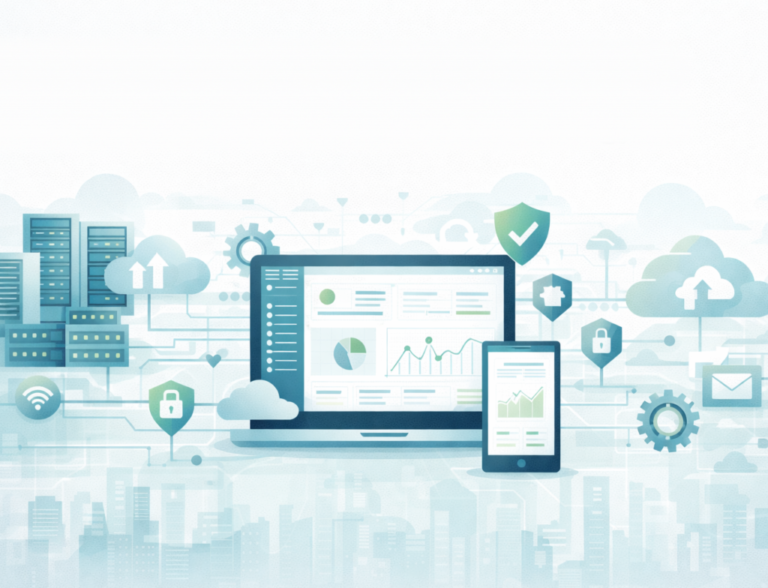
Keeping enterprise technology running smoothly requires more than just advanced hardware — it demands comprehensive, expert support. IT service providers deliver this essential foundation, transforming technology from a daily operational concern into a scalable competitive advantage that accelerates business growth.
This guide breaks down the core types of IT solutions and services for modern enterprises and provides actionable insights for selecting a provider that aligns with your strategic objectives.
This guide breaks down the core types of IT solutions and services for modern enterprises and provides actionable insights for selecting a provider that aligns with your strategic objectives.
What Are IT Services?
IT services encompass the technical expertise, infrastructure management, and strategic support that enable and optimise business processes.
These services range from foundational help desk support and cybersecurity to advanced network management, cloud computing, and technology roadmap planning.
In essence, IT service providers empower organizations to leverage technology effectively, freeing in-house teams from complex technical burdens and allowing them to focus on core business expertise.
These services range from foundational help desk support and cybersecurity to advanced network management, cloud computing, and technology roadmap planning.
In essence, IT service providers empower organizations to leverage technology effectively, freeing in-house teams from complex technical burdens and allowing them to focus on core business expertise.
Core Types of IT Services for Enterprises
Identifying the right IT support model is crucial. Here are the essential IT services offered by professional providers:
1. Help Desk & Technical Support
This service provides users with a single, centralized point of contact for resolving technical issues—from password resets to software malfunctions.
A quality help desk offers multi-channel support (phone, chat, email), clear escalation protocols, and transparent ticket tracking to ensure timely resolutions and maintain productivity.
A quality help desk offers multi-channel support (phone, chat, email), clear escalation protocols, and transparent ticket tracking to ensure timely resolutions and maintain productivity.
2. Managed IT Services
Managed IT Services involve the proactive, ongoing management of your IT infrastructure by a specialized third-party provider.
This model focuses on prevention, with providers continuously monitoring systems, applying patches, and resolving issues before they cause business disruption.
It’s a key reason why over 75% of enterprises outsource critical IT functions to Managed Service Providers (MSPs).
This model focuses on prevention, with providers continuously monitoring systems, applying patches, and resolving issues before they cause business disruption.
It’s a key reason why over 75% of enterprises outsource critical IT functions to Managed Service Providers (MSPs).
Common managed services include:
• 24/7/365 network and performance monitoring
• Proactive patch management and system updates
• Endpoint device and server maintenance
• Comprehensive IT reporting and analytics
• Continuous security monitoring and threat remediation
This approach grants businesses access to enterprise-grade expertise without the overhead of a large internal IT department, enabling teams to concentrate on strategic activities.
3. Cybersecurity & Network Security
As threats grow in sophistication, basic defenses are insufficient. Professional network security services provide layered protection
through managed firewalls, intrusion detection, vulnerability assessments, and incident response planning.
These services are critical for maintaining regulatory compliance and defending against evolving cyber threats.
through managed firewalls, intrusion detection, vulnerability assessments, and incident response planning.
These services are critical for maintaining regulatory compliance and defending against evolving cyber threats.
4. Structured Cabling & On-Site Field Support
Physical infrastructure remains the backbone of IT. Field services like structured cabling, hardware installation, and break/fix support are vital, especially for multi-site operations.
These services ensure that remote management is seamlessly complemented by hands-on technical expertise at every location.
These services ensure that remote management is seamlessly complemented by hands-on technical expertise at every location.
5. Cloud Services & Migration
Cloud adoption is now standard; a 2025 report indicates 60% of organizations rely on managed cloud services.
Cloud solutions host data and applications off-site, enhancing scalability, accessibility, and disaster recovery.
Key cloud services include:
Cloud storage, backup, and disaster recovery
Virtual Desktop Infrastructure (VDI)
Software as a Service (SaaS) management
Infrastructure as a Service (IaaS) provisioning
This model shifts IT from a capital expense (CapEx) to a predictable operational expense (OpEx), offering unparalleled flexibility.
Cloud solutions host data and applications off-site, enhancing scalability, accessibility, and disaster recovery.
Key cloud services include:
Cloud storage, backup, and disaster recovery
Virtual Desktop Infrastructure (VDI)
Software as a Service (SaaS) management
Infrastructure as a Service (IaaS) provisioning
This model shifts IT from a capital expense (CapEx) to a predictable operational expense (OpEx), offering unparalleled flexibility.
4 Strategic Ways IT Services Drive Business Results
The right IT partnership delivers tangible business outcomes beyond technical support.
1. Maximized Uptime & Productivity
Proactive monitoring and rapid incident response from IT providers minimize costly downtime.
Experts swiftly resolve issues to keep your systems—and your business—operational.
Experts swiftly resolve issues to keep your systems—and your business—operational.
2. Informed Strategic Technology Planning
IT partners provide strategic guidance on long-term initiatives like infrastructure upgrades, cloud migration, cybersecurity frameworks, and vendor consolidation.
This aligns your technology investments directly with business goals, mitigating risk and uncovering competitive opportunities.
This aligns your technology investments directly with business goals, mitigating risk and uncovering competitive opportunities.
3. Scalable, Flexible Growth
IT services allow you to scale resources effortlessly during expansion—such as opening new locations or onboarding staff—without the delay and cost of hiring full-time employees.
Services can be tailored or scaled based on current needs.
Services can be tailored or scaled based on current needs.
4. Enhanced Cost Efficiency & Predictability
Outsourcing IT converts variable, unexpected costs into predictable monthly expenses.
You gain access to enterprise-grade tools and deep expertise without the overhead of salaries, training, and benefits associated with a large in-house team.
You gain access to enterprise-grade tools and deep expertise without the overhead of salaries, training, and benefits associated with a large in-house team.
Why Modern Businesses Need Comprehensive IT Solutions
Today’s enterprises rely on IT services for strategic enablement:
Remote Work Enablement:
Secure, reliable access to tools and data from any location via managed VPNs, cloud solutions, and secure device provisioning.
Robust Disaster Recovery & Business Continuity:
Protection against data loss with automated backup systems and tested recovery plans for outages, disasters, and cyber-attacks.
Simplified Vendor Management:
Streamlined coordination and procurement across multiple technology vendors, ensuring system compatibility and reducing administrative overhead.
Regulatory Compliance & Audit Support:
Assistance in establishing and maintaining compliance with frameworks like HIPAA and GDPR through documented controls and security protocols.
Technology Training & Adoption:
Programs that ensure your team leverages new tools effectively and adheres to security best practices, maximizing ROI on technology investments.
Enterprise IT Services, Delivered at Scale
Reliable IT services simplify complex technology demands, from help desk support and cabling to full-scale infrastructure management.
The right partner delivers enterprise-class support that evolves with the technological landscape across all your locations.
At GOIP, we specialize in supporting multi-location enterprises across the APAC region with a comprehensive suite from design and deployment to day-to-day management.
We combine centralized strategy with local, boots-on-the-ground support to provide IT services that propel your business forward.
The right partner delivers enterprise-class support that evolves with the technological landscape across all your locations.
At GOIP, we specialize in supporting multi-location enterprises across the APAC region with a comprehensive suite from design and deployment to day-to-day management.
We combine centralized strategy with local, boots-on-the-ground support to provide IT services that propel your business forward.
Ready to align your technology with your business goals?
Contact GOIP today to begin a conversation about a tailored IT service partnership.